Cost Accounting
Precise cost analysis that supports decisions and improves performance: we find the true cost of each product and service and build a costing system that curbs waste and supports pricing.
Cost accounting
When you know the true cost of every product, service and activity, decisions on pricing, growth and cutting waste rest on figures rather than guesswork.
The cost accounting service at Bader Farhan Al-Ahmad Office for Accounting, Auditing & Consulting is built on cost accounting, a branch of management accounting that enables an organization to determine the results of its operations over a given period. It records and analyzes the full cost of producing goods and delivering services by gathering data on each cost element from the various documents and notices: the cost of materials used, the cost of labor, and the cost of buying or producing the services that different activities need.
We turn that data into a costing system that fits your activity, and we choose with you the most suitable of the main cost accounting methods, according to the nature of your business and the goals of your financial analysis, then link it to your books so your cost figures and your financial statements tell the same story.
The result is information that answers management’s everyday questions: what does this unit or this project really cost us? What is the lowest price we can accept for a special order? Where is the waste, and which products or branches earn the most? How would a rise in a raw material price or in wages affect the margin?
What we deliver
01
Costing system design
We define cost elements, cost centers and the bases for allocating overheads, and document them in a clear procedures manual suited to your activity and the size of your organization.
02
Activity-based costing
We track how resources are consumed and assign costs to activities and products more precisely than traditional methods, so you know the true cost of each product or service.
03
Standard costing and variance analysis
We set a predetermined cost for each unit, then compare it with the actual cost to identify variances and analyze their causes, helping you control and improve costs.
04
Flexible budgets
We prepare budgets that reflect how costs change with activity or production levels, giving you flexibility in financial planning and a fairer assessment of performance.
05
Marginal costing and contribution margin
We focus on variable costs to calculate the contribution margin (revenue minus variable costs), the basis for decisions such as pricing and accepting special orders.
06
Job order and process costing
We apply job order costing to projects and one-off orders to show the profit on each, and process costing to continuous production to show the cost of each stage.
07
Inventory valuation and cost of sales
We calculate inventory cost and cost of goods sold on a basis that stays consistent from period to period, so it flows correctly into the financial statements and the tax return.
08
Profitability reports
Regular reports on the profitability of each product, service, client and branch, with break-even and cost-volume-profit analysis, so you know where to focus.
Direct and indirect costs
Direct costs are costs tied directly to the production of a specific product, service or project, such as the raw materials that go into a product and the wages of the workers who make it. They are charged to it in full, with no need for allocation.
Indirect costs are shared costs that cannot be traced directly to a single product, such as rent, electricity, supervision, maintenance and machine depreciation. It is hard to tell how much of them each product consumes, so they are allocated to products and services using suitable allocation bases or cost drivers. This is where a good costing system proves its worth: inaccurate allocation can make a profitable product look loss-making, or the other way round.
Why cost accounting matters for companies
- Decision-making: it gives managers accurate information for strategic decisions on pricing, the product mix and the efficient use of resources.
- Cost control: it lets management monitor costs and reduce waste, which increases profit.
- Performance improvement: it helps measure the company’s financial performance, identify areas for improvement and direct efficiency efforts.
Who needs cost accounting?
Any organization that sells a product or service and wants to know the real profit it makes on it: factories and workshops that need a unit cost, contracting and project companies that track the cost of each contract, trading companies that hold inventory, restaurants and hospitality businesses that cost each meal or service, and service firms that price their work by project or by the hour.
How we work
01
Understand the business and its cost flow
Through site visits and meetings with the people in charge, we learn about your products, services and process stages, and identify where costs arise and what consumes them.
02
Analyze current data
We analyze your documents and books to classify costs as direct or indirect and as fixed or variable, and measure the current cost of your main products and services as a baseline.
03
Build the model
We design the cost centers and allocation bases and choose the best method: standard, activity-based, marginal or a mix.
04
Implement and link to the books
We link the costing system to your accounting system, test it on a real period and train your team to enter the data and read the reports.
05
Monitor and refine
We provide regular variance and profitability reports with practical recommendations, and review the model whenever your activity, input prices or product range change.
FAQs about cost accounting
What is the difference between cost accounting and financial accounting?
Financial accounting prepares financial statements for users outside management, such as partners, banks and government bodies, under set standards. Cost accounting is an internal management tool that measures the cost of each product, service and activity to support pricing, control and planning. The two complement each other, because costing results feed into inventory valuation and cost of sales in the financial statements.
Do service companies need cost accounting?
Yes. A service company needs to know the cost of each project, contract, working hour or client so it can price its services at a sound margin and spot loss-making contracts early. Its cost structure is different: staff costs and overheads usually matter more than raw materials.
Which costing method suits my business?
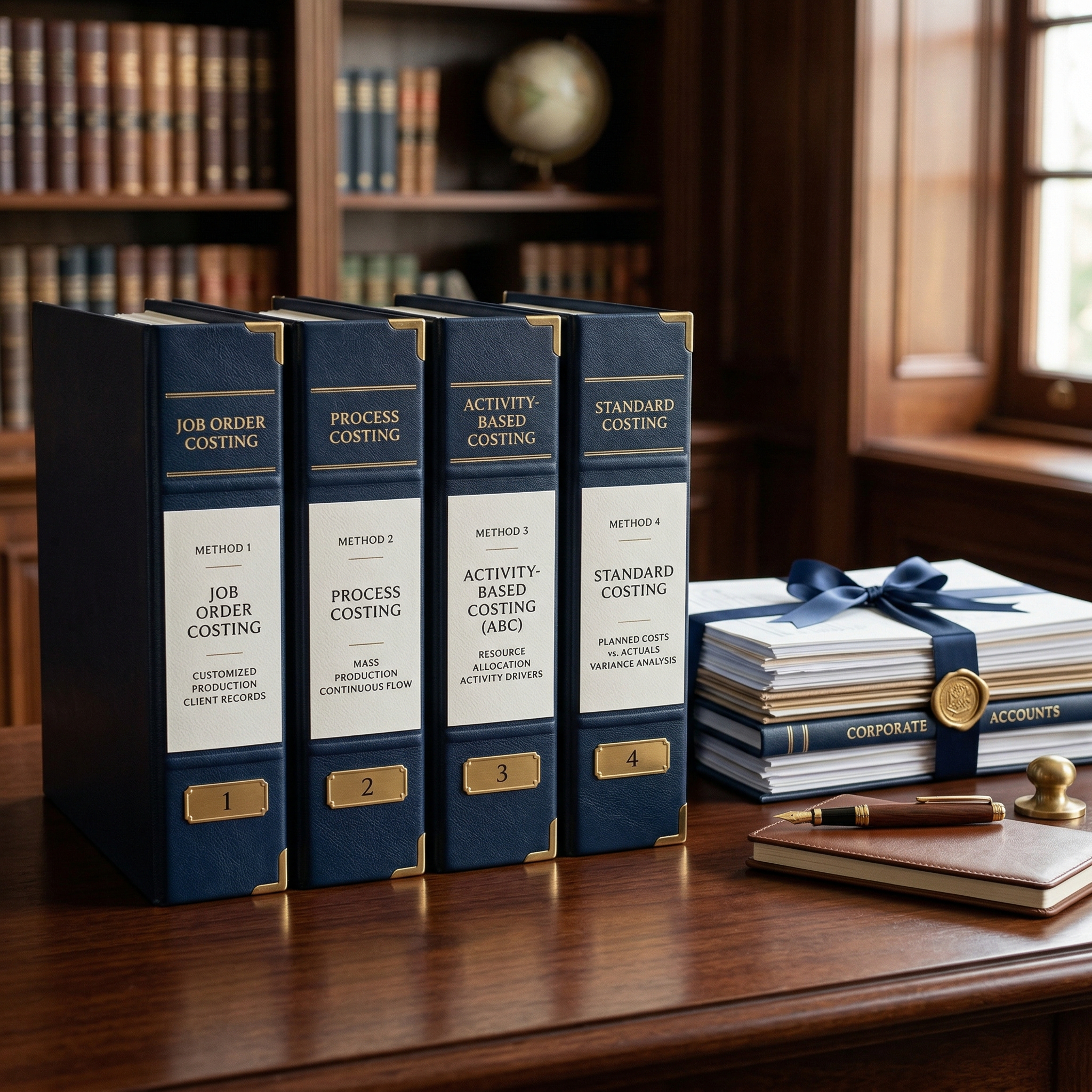
It depends on what you do. Job order costing suits projects and one-off orders, process costing suits continuous production, activity-based costing helps when overheads are large and varied, standard costing suits repetitive production, and marginal costing serves short-term pricing decisions. We often combine more than one method.
How long does it take to implement a costing system?
It depends on the number of products and services, your process stages and the quality of the data in your books. We start with a short assessment and then set a clear timeline for each stage of design and implementation.
Can the costing system be linked to our current accounting software?
In most cases, yes, through the cost centers, projects or analytical dimensions available in the software. If your software cannot support what you need, we propose the necessary changes through our accounting software design and implementation service.
Need advice on cost accounting?
Our team is here to help. Contact us now to discuss your company’s needs and receive a tailored proposal.